
If compliance lives only in people’s heads, it doesn’t exist
Over the past seven weeks, we have explored the key components of a sanctions compliance framework, from understanding sanctions risk and knowing your customer, through to screening, monitoring, reporting obligations and the prohibition on tipping-off.
A common thread runs through each of these obligations: sanctions compliance is not a collection of standalone controls. It is a system.
This brings us to Rule 8 of the Sanctions Framework: establishing and maintaining documented policies and procedures.
At first glance, this requirement may appear relatively straightforward. Most subject persons already have policies, procedures or compliance manuals in place. However, the purpose of Rule 8 extends beyond documentation. It is intended to ensure that sanctions compliance is applied consistently, understood by relevant personnel and capable of operating effectively regardless of who performs the task.
Put simply, if a key employee is absent tomorrow, would another person know how to onboard a customer, assess an ownership structure, investigate a sanctions hit or escalate a concern? That is often the real test of whether a framework exists in practice.
How Rule 8 brings the framework together
Unlike many of the obligations discussed in previous weeks, Rule 8 is not focused on a specific control. Instead, it provides the framework that allows the various sanctions controls to operate consistently in practice.
Rule 8 is, in many respects, the point at which the different components of the sanctions framework come together.
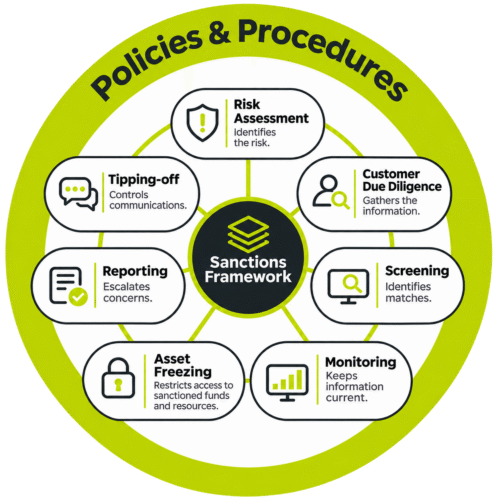
Without documented policies and procedures, these obligations can remain separate compliance requirements. With them, they become part of a coherent framework where responsibilities are assigned, decisions are made consistently and actions are performed in a structured manner.
For this reason, Rule 8 should not be viewed as a standalone obligation. It is the mechanism that operationalises many of the controls discussed throughout the first seven parts of this series.
Policies, procedures and the practical challenge of implementation
Whilst the terms are often used interchangeably, policies and procedures serve different purposes. A policy establishes the business’ approach and expectations in relation to sanctions compliance, whilst a procedure explains how those expectations are implemented in practice.
Many subject persons enhanced their sanctions frameworks by updating existing compliance manuals following legislative changes. Whilst this was a sensible starting point, policies that simply restate legal obligations often leave staff with an obvious question: “What am I expected to do?”
A document may accurately describe the law whilst providing little practical guidance on implementation. For this reason, effective sanctions procedures tend to focus on workflows rather than legal provisions.
For example, a sanctions screening policy may require the screening of customers, beneficial owners and other relevant parties. The corresponding procedure should explain who performs the screening, when it takes place, how potential matches are investigated, who is responsible for escalation and what records must be retained.
Rather than repeating legal requirements, procedures should explain how compliance is performed in practice, including when actions are required, who is responsible for them and how outcomes are documented. Without that level of practical direction, a policy can quickly become little more than a statement of intent.
The objective is to create a practical reference point that supports day-to-day decision-making.
What this looks like across different sectors
While the principles underpinning sanctions compliance are broadly similar, the procedures required to implement them can vary significantly depending on the services being provided.
For transaction-driven subject persons, particularly notaries and estate agents, procedures must address not only customers but also the various parties connected to a transaction, such as vendors, purchasers, donors, assignees, lenders and payers.
Another key consideration is that not all activities undertaken by a subject person necessarily constitute Relevant Activity for the purposes of Article 32. A notary may publish some deeds that fall within scope and others that do not. An accountant may provide both warrant-regulated and non-warrant-regulated services. In the gaming sector, applicability may depend on thresholds being met rather than the activity itself.
Policies and procedures should therefore clearly identify when the Article 32 obligations apply and when they do not. However, activity that falls outside the definition of Relevant Activity may still create sanctions risk exposure. The distinction is that the specific obligations arising under Article 32 would not apply to that activity.
Monitoring expectations can also differ considerably. A credit or financial institution may require continuous monitoring throughout a business relationship, whereas an auditor may primarily revisit sanctions considerations during the annual audit cycle. Policies and procedures should reflect how monitoring is expected to occur within the context of the services actually being provided.
The underlying principle remains the same: policies and procedures should reflect how the business actually operates, rather than how another business operates. This is one reason why generic templates often have limited value unless they are carefully adapted to the specific services, customers and risk profile of the subject person.
The risk of key-person dependency
For many Maltese subject persons, particularly sole practitioners and smaller firms, sanctions compliance can become heavily dependent on the knowledge and experience of a small number of individuals.
The challenge often arises when those individuals become unavailable. A Sanctions Compliance Officer may be on leave when a sanctions alert is generated, a senior administrator may leave the business, or an outsourced compliance arrangement may come to an unexpected end. In such cases, critical knowledge can reside with specific individuals rather than within the framework itself.
This is where documented policies and procedures serve a purpose beyond regulatory compliance. They help preserve institutional knowledge, create continuity and ensure that sanctions obligations can continue to be discharged consistently.
Viewed from this perspective, policies and procedures form part of a business’ operational resilience framework. A well-documented process can reduce disruption, support succession planning and promote consistency in sanctions-related decision-making.
The impact of size on policies and procedures
The size and operating model of a subject person can be just as important as the sector in determining what an effective policies and procedures framework looks like in practice.
For larger businesses, policies and procedures often need to address multiple layers of responsibility. Screening alerts may pass through operational staff, compliance personnel and senior management, requiring clearly documented roles, approval thresholds and escalation routes.
Smaller subject persons face different challenges. Sole practitioners and very small firms often question the need for detailed written procedures when there are few or no employees requiring instruction. However, documented procedures serve a broader purpose. They provide evidence of how sanctions obligations would be addressed in practice, including how unfamiliar scenarios, potential matches and reporting decisions would be handled.
The level of detail required may differ significantly between a sole practitioner and a large institution. Proportionality should not be confused with simplification. A sole practitioner may require fewer procedures than a large institution, but should still be capable of demonstrating how sanctions obligations would be discharged in practice.
Ultimately, policies and procedures should be proportionate to the nature, size and complexity of the business whilst providing sufficient guidance to ensure sanctions obligations can be performed consistently and effectively.
The link between procedures, training and governance
Policies and procedures do not operate in isolation. They sit at the centre of several other components of the sanctions framework.
Policies and procedures should also not be viewed as static documents. They should be reviewed periodically to reflect changes in sanctions obligations, customer risk exposure and business operations.
Training becomes more effective when staff are trained on documented internal processes rather than abstract legal concepts. Governance becomes more effective when responsibilities have been formally assigned and documented, while monitoring becomes more effective when there is a clear process against which implementation can be assessed.
Final thoughts
Rule 8 is not simply about maintaining a sanctions policy or procedure manual. It is about translating sanctions obligations into clear, consistent and repeatable actions.
Whether a subject person operates in the real estate sector, accountancy profession, gaming sector or financial services industry, the same question ultimately applies: if a sanctions-related issue arose tomorrow, would the business know what to do, who is responsible and how the matter should be escalated?
Well-designed policies and procedures provide that clarity. They help transform individual compliance obligations into a functioning framework that can operate consistently across the business.
Next week
Part 9 of 13 – Record Keeping
Policies and procedures only have value if compliance can be demonstrated.
In Week 9, we will examine Rule 9: Record keeping and why evidence is one of the most critical components of an effective sanctions framework.
Contact us to discuss what these requirements mean for your business and how Komply can help you meet your compliance obligations with confidence.